

Madonna has paid an emotional tribute to William Orbit, the producer who helped her create Ray of Light and, in the process, became part of one of the most important transformations of her career. Looking back on their time together, Madonna described meeting Orbit as an “epiphany,” remembering a creative relationship that pushed her into unfamiliar musical territory and ultimately produced one of the most celebrated albums of the 1990s. “I realized that music did not have to fit into categories or genres. So we created our own,” Madonna wrote. “You pressed a magic button inside of me and I fell into a galaxy of unrealized dreams. Your music gave me a magic carpet to fly on and I visited many places. Sad and Joyful. I sang in ways I’d never sung before.”
It’s almost impossible to talk about William Orbit without eventually arriving at Ray of Light. Released in 1998, the album represented a dramatic shift for Madonna, replacing much of the polished pop production associated with her earlier work with something more atmospheric, electronic and adventurous. Ambient textures, restless beats, guitars and shimmering synthesizers moved in and out of songs that could feel equally at home in a club or through a pair of headphones late at night. Madonna was changing personally as well. Her daughter Lourdes had recently been born, and she was entering a period that seemed to reshape the way she approached both her life and her music. Orbit arrived at exactly the right moment. “In many ways you were my Ray of Light, as was my daughter Lola who was born around this time,” she wrote. “I was starting a new chapter, I was choosing another road to walk down, and you were right by my side with your crooked teeth and your genius way of hearing music.”
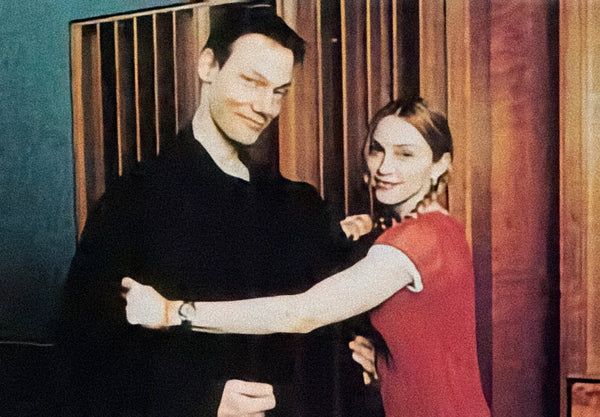
That “genius way of hearing music” had been developing long before Orbit stepped into the studio with Madonna. Born William Mark Wainwright in London in 1956, Orbit built his career away from the traditional path of a mainstream pop producer. He became immersed in electronic and experimental music, formed the group Torch Song in the early 1980s and later developed his Strange Cargo series, exploring ambient and electronic soundscapes at a time when those sounds still existed largely outside mainstream pop. Orbit never seemed particularly interested in the boundaries separating genres. Electronic music, rock, ambient, pop and even classical music could all become part of the same sonic world, and that curiosity eventually made him one of the most distinctive producers of his generation.
His career stretched well beyond Madonna. Orbit worked with an eclectic collection of artists including Blur, U2, All Saints, Beth Orton, P!nk, Britney Spears, Robbie Williams and No Doubt, moving comfortably between experimental records and huge pop productions. His work with All Saints on “Pure Shores” became another unmistakable example of his sound, wrapping the song in dreamy electronics and an almost weightless atmosphere, while his production on Blur’s 13 showed a darker and more experimental side of his approach. Orbit also continued releasing music under his own name, and with Pieces in a Modern Style he turned toward classical compositions, filtering them through electronics and once again demonstrating how little interest he had in keeping different musical worlds apart.
Still, Ray of Light became the record where Orbit’s ideas collided with mainstream pop on the largest possible scale. Rather than simply adding electronic beats underneath Madonna’s songs, the pair seemed willing to disappear into the music and see where it took them. “The studio was often church like and I would sit in silence, waiting for your ideas to explode out of your keyboard or your guitar and then I would run with them,” Madonna recalled. That sense of discovery can be heard throughout the album, from the hypnotic opening of “Drowned World/Substitute for Love” and the icy atmosphere of “Frozen” to the rush of the title track and the dreamlike spaces surrounding songs like “Swim” and “The Power of Good-Bye.” Madonna herself sounded different, too. Her vocals were more open, searching and vulnerable, something she directly connected to the creative environment Orbit helped create.
The result was an album that managed to sound experimental without losing Madonna’s instinct for a great pop song. Ray of Light went on to become one of the defining records of the late 1990s and earned four Grammy Awards, including Best Pop Album, while its title track won Best Dance Recording. Its larger impact, however, can be heard in what came afterward. The album arrived at a time when electronic music was increasingly pushing beyond clubs and underground scenes, and it showed that one of the biggest pop stars in the world could fully embrace those sounds without watering them down. Today, when pop records routinely move between house, techno, ambient music and countless other electronic influences, it can be easy to forget just how adventurous that combination felt at the time. Orbit helped make that crossover feel natural.
For Madonna, though, the memories appear to go far beyond awards, production techniques or the album’s influence. Her tribute paints a picture of two artists discovering something together, often without knowing exactly where an idea would lead. “I miss those days,” she wrote. “Only you could inspire me to write a song like ‘Drowned World’ or ‘Swim’. You were so otherworldly. So singular.” Otherworldly is an appropriate description for Orbit’s work. Even his most accessible productions often contained something unusual beneath the surface — an unexpected texture, a guitar transformed into something barely recognizable, a synthesizer floating in the distance or a beat that seemed to pull a song somewhere it wasn’t originally supposed to go. His productions could feel futuristic without becoming cold, and enormous without becoming crowded.
Madonna and Orbit would work together again after Ray of Light, including on “Beautiful Stranger” and, years later, during the period surrounding MDNA, but it was those original sessions that Madonna returned to most vividly in her farewell. “The years passed and I moved on to make music with other people, but I have never forgotten you or the magical time we spent together,” she wrote. Then came a final goodbye that felt less like one global superstar remembering a famous producer and more like one old friend saying farewell to another: “Goodbye Billy Bubbles. I was so lucky to have known you and fallen down the rabbit hole with you.”
More than two decades after Ray of Light, the music Madonna and Orbit made together still feels remarkably alive. It captured two artists at a moment when neither seemed particularly interested in following the rules, and that willingness to explore helped create an album whose influence continues to run through pop and electronic music today. William Orbit helped Madonna discover an entirely new musical world, while Madonna gave Orbit one of the biggest stages imaginable on which to share his strange, beautiful and unmistakably individual approach to sound. Somewhere in the middle, as Madonna put it herself, they stopped worrying about categories and created their own.